
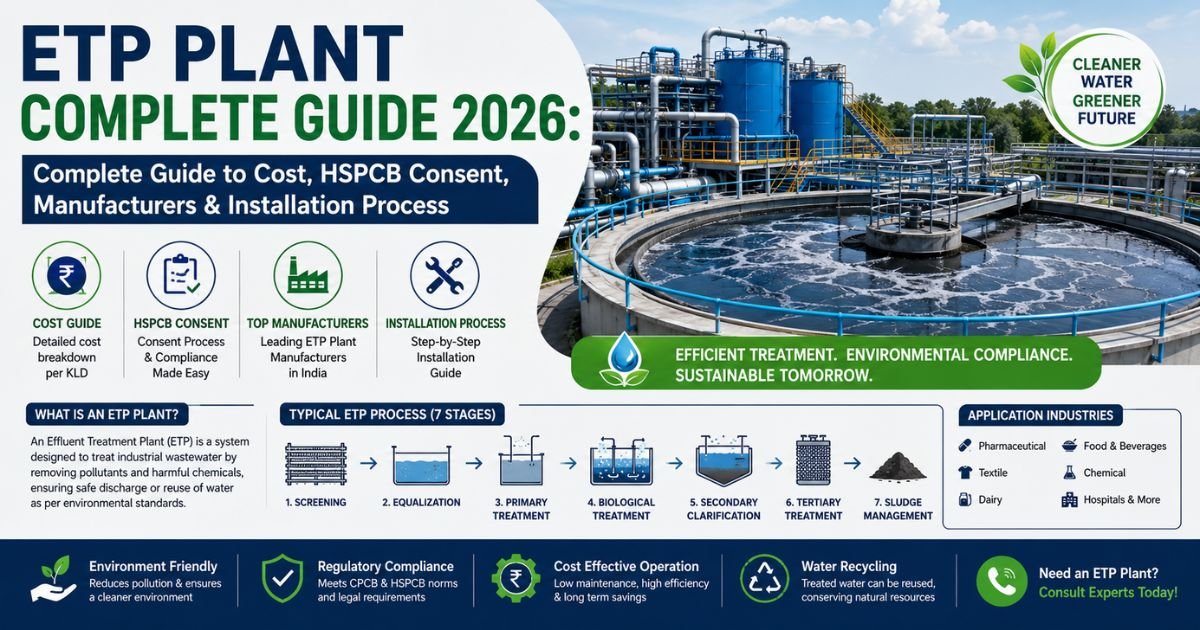
An ETP Plant Complete Guide 2026 is useful for industries that generate wastewater during manufacturing and processing activities. An Effluent Treatment Plant (ETP) is designed to treat industrial wastewater before it is discharged, reused or sent for further treatment. Industries such as textile, pharmaceutical, food, dairy and chemical manufacturing may require different ETP technologies depending on the characteristics of their wastewater.ETP Plant Complete Guide 2026
In India, industrial units are required to meet applicable effluent standards and consent conditions. CPCB documents also emphasise treatment of wastewater to prescribed standards and encourage recycling and reuse wherever practicable.
What Is an ETP Plant and How Does It Work? ETP Plant Complete Guide 2026
An ETP plant, or Effluent Treatment Plant, is a wastewater treatment system used primarily for treating industrial effluent. The purpose is to reduce pollutants such as suspended solids, organic matter, oil and grease, chemicals and other contaminants before the treated water is discharged or reused.
The design of an ETP depends on the industry, wastewater quality, daily flow and required treated-water standards. For example, a textile industry’s wastewater can have different characteristics from pharmaceutical or dairy wastewater, so the treatment process cannot be identical for every industry.
A typical ETP may include collection, screening, equalisation, chemical treatment, biological treatment, clarification, filtration and sludge management. CPCB industry-specific standards can specify parameters such as pH, BOD, COD and suspended solids, with requirements varying by industry and discharge route.
ETP Plant Working Process: 7 Main Steps:ETP Plant Complete Guide 2026
The exact process can vary, but a typical ETP plant working process can be explained through these seven stages:ETP Plant Complete Guide 2026
- Screening: Large solids and unwanted materials are removed from incoming wastewater.
- Collection and Equalisation: Wastewater is collected and its flow and characteristics are equalised to provide a more consistent feed to subsequent treatment units.
- Primary Treatment: Physical and chemical processes help remove suspended solids and other contaminants. Coagulants and flocculants may be used where required.
- Biological Treatment: Microorganisms break down biodegradable organic matter. Technologies such as activated sludge, MBBR or other biological systems may be selected according to wastewater characteristics.
- Secondary Clarification: Biological solids are separated from the treated water through settling.
- Tertiary Treatment: Additional filtration or advanced treatment may be used to achieve the required water quality. Depending on the application, systems can include sand filters, activated carbon filters, membrane processes or disinfection.
- Sludge Treatment and Disposal: Sludge generated during treatment is collected, dewatered and managed according to applicable requirements.
ETP Plant Complete Guide 2026
This process is only a general framework. A properly engineered ETP needs to be designed according to actual wastewater analysis and the applicable discharge or reuse standards.
ETP Plant Complete Guide 2026: What Determines the Price?
The ETP plant cost in India 2026 can vary significantly because there is no single price applicable to every industry. Capacity is one of the most important factors, but technology, wastewater characteristics, automation, civil work, equipment selection and required treatment quality also affect the final cost.
For this reason, searches such as ETP plant cost per KLD, ETP plant cost 10 KLD, ETP plant cost 50 KLD, ETP plant cost 100 KLD, ETP plant cost 250 KLD, ETP plant cost 500 KLD and ETP plant cost 1 MLD can produce very different estimates.
The cost may also differ according to application. An ETP plant for textile industry, pharma industry, dairy industry, food industry, chemical industry or a hospital may require different treatment stages.
Therefore, the best way to determine the ETP plant price is to evaluate the required capacity and wastewater characteristics first, followed by a detailed technical design and quotation.
How Much Does a 1 KLD ETP Plant Cost?ETP Plant Complete Guide 2026
There is no fixed nationwide price for a 1 KLD ETP plant. A small ETP’s cost depends on technology, materials, automation, treatment requirements, installation and the quality of the incoming wastewater.ETP Plant Complete Guide 2026
Instead of comparing only the ETP plant price per KLD, buyers should compare the complete scope of supply, including equipment, tanks, pumps, control panels, installation, commissioning and after-sales support.
Types of ETP Plants and Treatment Technologies
There are several types of ETP configurations, now here you get ETP Plant Complete Guide 2026 and the right option depends on the wastewater generated by the industry.ETP Plant Complete Guide 2026
Common technologies include:
- Physical treatment systems
- Chemical treatment systems
- Biological treatment systems
- MBBR-based ETP
- Activated sludge systems
- Membrane-based treatment
- RO-based water recovery systems
- Zero Liquid Discharge (ZLD) systems
ETP Plant Complete Guide 2026-The seven commonly discussed water-treatment methods include screening, coagulation, flocculation, sedimentation, biological treatment, filtration and disinfection. In industrial applications, additional processes may be required depending on the pollutants involved.
For example, high-TDS wastewater may require specialised treatment, while wastewater containing colour, heavy metals or toxic chemicals may need additional processes. CPCB maintains industry-specific standards for several industrial sectors, including pharmaceuticals and chemicals.
ETP Plant Manufacturers, Suppliers & Compliance in India
When selecting ETP plant manufacturers in India, buyers should look beyond the initial ETP plant price. A reliable manufacturer or supplier should be able to understand the industry’s wastewater characteristics, recommend suitable technology, provide technical documentation and support installation and commissioning.
Businesses searching for ETP plant manufacturers, ETP plant suppliers or ETP plant companies should evaluate experience, project references, technical expertise, equipment quality and after-sales service.
For companies located in the National Capital Region, searches such as ETP plant in Gurugram, ETP plant in Delhi, ETP plant in Haryana, ETP plant in NCR, ETP plant in Manesar and ETP plant in IMT Manesar can help identify suppliers operating near the project location.
Compliance is equally important. CPCB directions have stated that industries requiring consent to operate must have a functional ETP capable of meeting applicable prescribed standards and consent conditions.
Frequently Asked Questions About ETP Plants
What is meant by ETP plant?
ETP stands for Effluent Treatment Plant. It is a treatment system used to remove pollutants from industrial wastewater before discharge, reuse or further treatment.
How much does a 1 KLD ETP plant cost?
There is no fixed price. The cost depends on wastewater characteristics, treatment technology, equipment, automation, installation and required treated-water quality.
What are the 7 steps in wastewater treatment?
A typical industrial process can include screening, equalisation, primary treatment, biological treatment, clarification, tertiary treatment and sludge management.
How many types of ETP plants are there?
There is no single fixed number. ETPs can use physical, chemical, biological, membrane and advanced treatment technologies, often combined into a customised system.
What are the 7 methods of water treatment plants?
Common treatment methods include screening, coagulation, flocculation, sedimentation, biological treatment, filtration and disinfection. The actual process depends on the quality and intended use of the treated water.
Is an ETP mandatory for every industry?
Requirements depend on the industry’s activities, wastewater generation, applicable regulations and consent conditions. Industries requiring consent must meet the conditions and applicable effluent standards set by the relevant authorities.
Conclusion
An ETP is an important part of industrial wastewater management and environmental compliance. The correct system depends on wastewater flow, pollutant load, industry type, discharge requirements and the desired level of water reuse.
Before purchasing an ETP, businesses should compare technology, capacity, operating cost, maintenance requirements, compliance capability and supplier support rather than focusing only on the initial ETP plant cost in India 2026.