
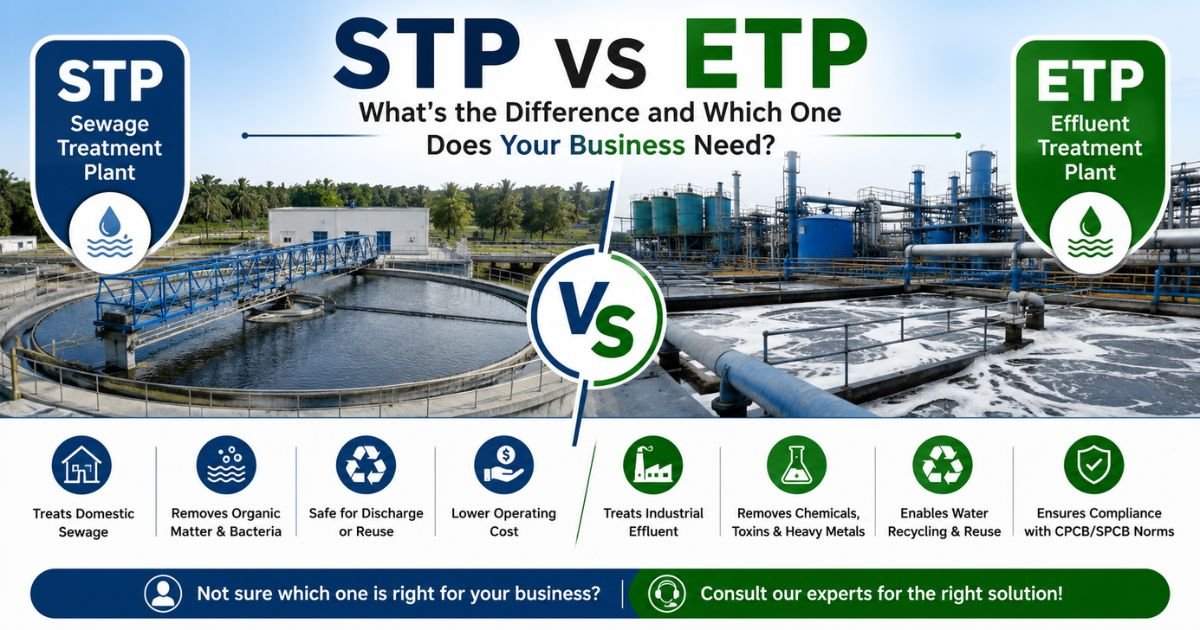
In today’s industrial and commercial landscape, wastewater management is more important than ever. Environmental regulations are becoming stricter, water scarcity is increasing, and businesses are under pressure to reduce their environmental impact. Two of the most common wastewater treatment systems are Sewage Treatment Plants (STP) and Effluent Treatment Plants (ETP). Although these systems may appear similar, they serve very different purposes. Understanding the difference between STP and ETP is essential for choosing the right solution for your business.
What is an STP (Sewage Treatment Plant)?
A Sewage Treatment Plant (STP) is designed to treat domestic wastewater generated from residential, commercial, and institutional facilities. This includes wastewater from toilets, bathrooms, kitchens, cafeterias, and washing areas. The main objective of an STP is to remove organic matter, suspended solids, bacteria, and harmful microorganisms before the treated water is discharged or reused.
STPs are commonly installed in:
- Residential Apartments
- Commercial Buildings
- Hotels & Resorts
- Hospitals
- Schools & Universities
- Shopping Malls
- Office Complexes
Key Benefits of an STP
- Recycles wastewater for gardening and flushing
- Reduces freshwater consumption
- Helps meet environmental regulations
- Lowers water bills
- Protects groundwater and nearby water bodies
What is an ETP (Effluent Treatment Plant)?
An Effluent Treatment Plant (ETP) is specifically designed to treat industrial wastewater generated during manufacturing and production processes. Industrial effluent often contains chemicals, oils, heavy metals, acids, alkalis, dyes, and toxic contaminants that cannot be treated by a standard sewage treatment system.
ETPs are widely used in industries such as:
- Textile Manufacturing
- Pharmaceutical Companies
- Chemical Industries
- Food & Beverage Processing
- Paper Mills
- Automobile Manufacturing
- Electroplating Units
- Paint & Dye Industries
Key Benefits of an ETP
- Removes hazardous pollutants from industrial wastewater
- Ensures compliance with CPCB/SPCB norms
- Prevents environmental pollution
- Enables water recycling and reuse
- Reduces disposal costs
STP vs ETP: Key Differences
| Feature | STP | ETP |
|---|---|---|
| Full Form | Sewage Treatment Plant | Effluent Treatment Plant |
| Wastewater Source | Domestic sewage | Industrial wastewater |
| Main Purpose | Remove organic waste and pathogens | Remove chemicals and toxic contaminants |
| Waste Characteristics | Biodegradable | Chemical, toxic, oily, heavy metals |
| Treatment Process | Mainly biological treatment | Physical, chemical & biological treatment |
| Installation Areas | Apartments, Hotels, Offices | Factories and Manufacturing Plants |
| Complexity | Moderate | High |
| Operating Cost | Lower | Higher |
Which Businesses Need an STP?
An STP is the right choice if your facility primarily generates domestic sewage. Examples include:
- Residential Societies
- Corporate Offices
- Educational Institutions
- Hotels
- Hospitals
- Shopping Malls
- IT Parks
- Airports
If your wastewater mainly comes from washrooms, kitchens, and staff facilities, an STP is usually sufficient.
Which Businesses Need an ETP?
An ETP is essential if your business generates wastewater during industrial production or manufacturing. Industries that commonly require ETPs include:
- Chemical Plants
- Textile Industries
- Pharmaceutical Manufacturers
- Food Processing Units
- Dairy Plants
- Breweries
- Metal Finishing Industries
- Automobile Manufacturing Units
These facilities produce wastewater that contains pollutants requiring specialized treatment before discharge.
Can a Business Need Both STP and ETP?
Yes. Many industrial facilities require both systems because they generate two different types of wastewater.
For example, a pharmaceutical factory may produce:
- Domestic sewage from employee washrooms and cafeterias
- Industrial effluent from manufacturing processes
In such cases:
- STP treats domestic wastewater.
- ETP treats industrial wastewater.
Using separate treatment systems ensures efficient operation and regulatory compliance.